
Haats as a part of the Local Food Systems
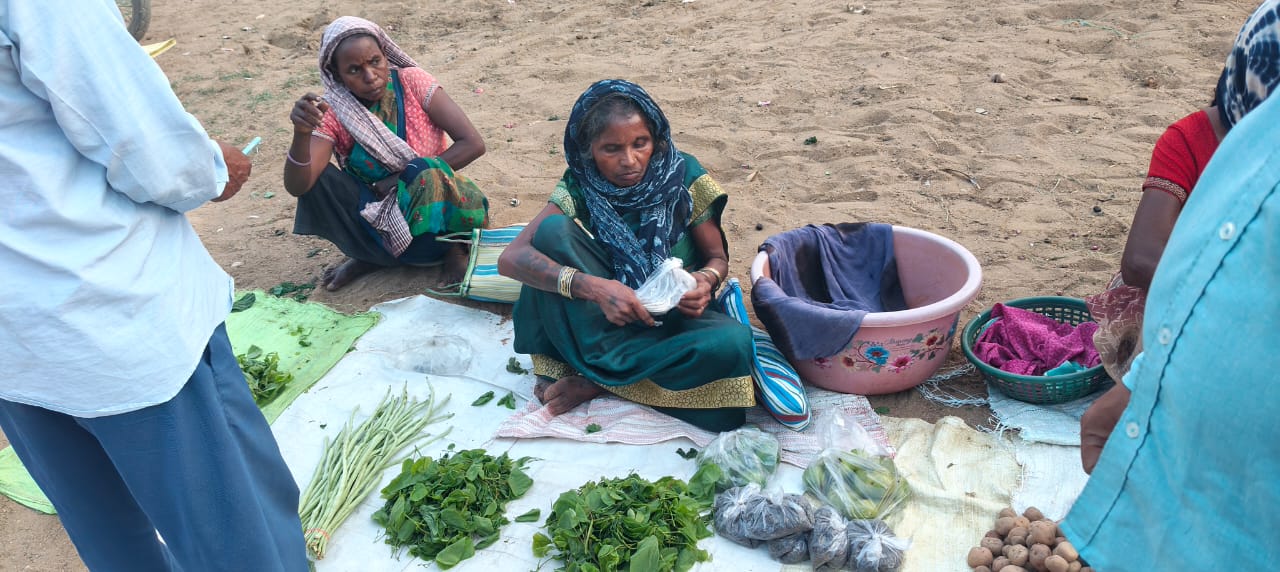
The day of Haat in rural and tribal Chhattisgarh, is not just a market day-it’s the day when the rituals of food, social exchange, and community life come together. Through our ongoing food systems and nutrition research in rural and tribal areas of Chhattisgarh, we observed how communities produce, procure, prepare, and consume food. Across study sites, weekly informal markets, locally known as haats emerged as a central component of the local food environment.
Our formative research found that most households depend on these markets for food access, highlighting how dominant they are in everyday food choices and what families consume at home. Typically, households access a nearby haat operating once or twice a week within about two to five kilometres, to purchase cooking oil, spices, packaged foods, and freshly prepared sweets and savouries. They also provide access to indigenous and non-indigenous pulses, fruits, vegetables, roots and tubers, wild mushrooms, and local fermented rice beer, locally known as hadiya, for household consumption.
Haats as Hubs of Food, Livelihood, and Community Life
Weekly haats are more than spaces of economic exchange. They bring together a community’s access to food, livelihoods and social interaction in one setting. Community members sell foraged foods, cultivated produce, and non-food commodities; purchase household essentials; interact with familiar sellers; negotiate prices; and exchange local information. In some cases, large farmers or intermediaries/middlemen aggregate produce from smallholder farmers and sell them in the haat, illustrating the role of these markets in local aggregation and small-scale trading networks.
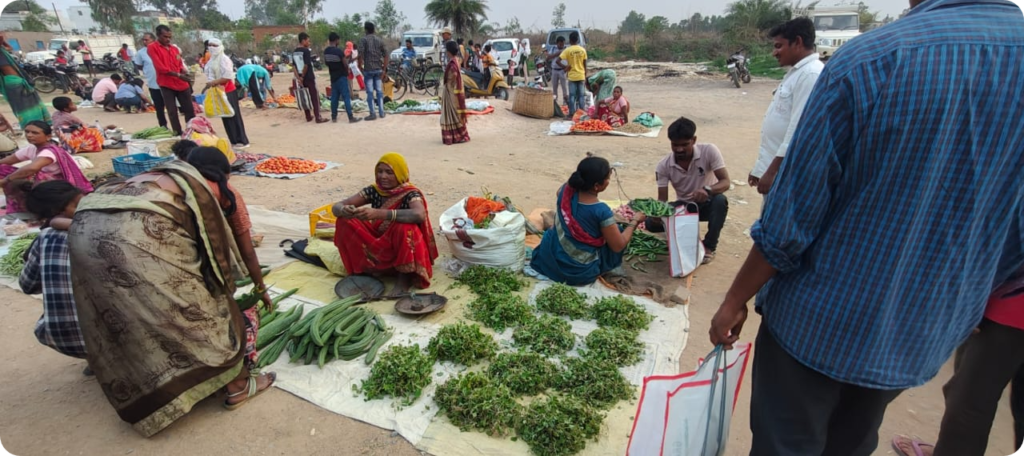
The vibrant environment of these markets reflects indigenous approaches to food promotion. Sellers sit behind carefully arranged, distinct piles of fresh produce, using familiar local calls such as “le tamatar kha tamatar, 20 rupiye kilo” to attract buyers. These interactions provide a clear illustration of how local food systems are closely linked to income generation, access to nutritious diets, and everyday social exchange.
From a nutrition perspective, haats have considerable potential to support dietary diversity by bringing locally grown, seasonal, and indigenous foods closer to rural and tribal households. By enabling farmers and gatherers from within the community to sell their produce locally, these markets shorten supply chains and improve access to diverse foods for households that may not grow diverse foods in their own farms or backyard gardens.
Beyond fresh produce, haats are dynamic food environments where freshly prepared local snacks, chicken, fish and hadiya are purchased, consumed, and shared. As people gather to eat and socialise, these markets become important spaces where food behaviours are shaped by product availability, affordability, and promotion.
However, in recent times these markets are being increasingly utilized for the sale of commercial packaged food products. Cheap, calorie-dense, ultra-processed foods are often promoted through bright packaging, attractive displays, and small, affordable portions that appeal to low-income consumers, including children and young adults. In some instances, products resembling well-known brands are sold under similar-sounding names. Such observations point to the need for stringent food quality monitoring in this informal food environment and the importance of nutrition education on food labels among consumers.
Similarly, while freshly prepared local snacks are an important part of the haat experience and traditional cuisine, limited quality monitoring may raise food safety concerns, particularly where reused and thermally abused oils, artificial colours, synthetic additives, or unhygienic preparation and storage practices are involved.
One field observation explained the
significance of visits to the weekly haat as an integral part of household activity plan. During household surveys, several participants politely declined interviews, not out of disinterest, but because it was the “haat day”. Since the haat operated only once a week, this was their only opportunity to purchase vegetables and other essentials for the days ahead. This interaction showed that visiting haat was not a casual outing, but an essential weekly activity directly linked to food access. It also highlighted how household routines, mobility, and food procurement are organised around the market calendar.
Eating with the Seasons: Where Haats Mirror Nature’s Cycles
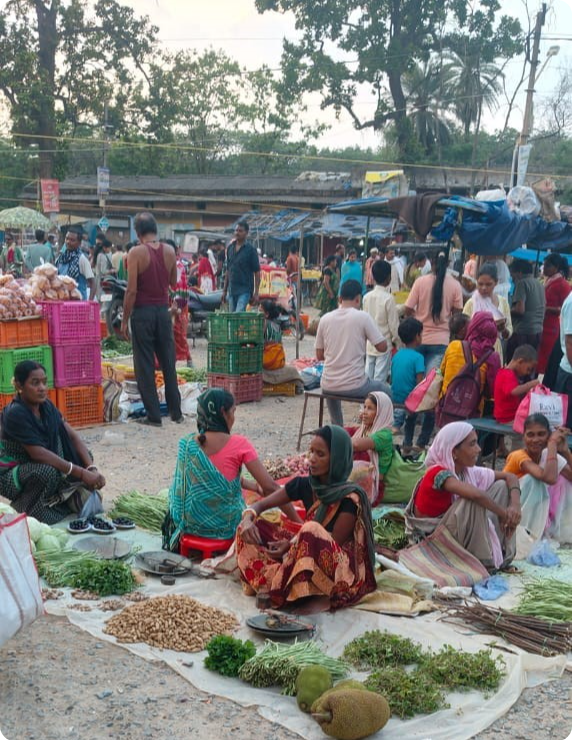
Seasonality is closely linked with dietary diversity in agrarian and traditional food systems1. Foods available in haats change with season. Wild mushrooms such as putu and khukhdi are available mainly during the monsoon. In winter, tubers, green leafy vegetables, and fruits such as sahtut (mulberry) are commonly found, while summer brings foods such as koilar bhaji (Bauhinia variegata), tendu (Indian ebony fruit), and jamun (Indian blackberry). Seasonal variation affects production, availability, price, and consumption, thereby influencing dietary diversity. For lean seasons, traditional food preservation practices are followed, and sundried foods such as green leafy vegetables (sukti), wild mushrooms, and fish are sold in the markets.
Access to food through haats is influenced not only by food availability, but also by household purchasing power, intra-household demands, and nutritional knowledge and awareness. For instance, a woman purchasing a small bundle of greens, a portion of pulses, and a local tuber is making a practical food decision shaped by price, preference, and household requirements. Such everyday market interactions offer valuable entry points for context-specific nutrition education. They also reflect agriculture-nutrition pathways, which highlight how agriculture can influence nutrition through food production, food prices, income generation, and women’s participation in food-related decision making
From Forest to Weekly Haats: Sustaining Traditional Ecological Knowledge
The continued presence of forest-foraged foods in haats shows that communities recognise, value, and continue to use these foods for household consumption. Demand is shaped by seasonality, taste, familiarity, affordability, and traditional ecological knowledge passed through generations. As forest-foraging declines due to shifting livelihoods, time constraints, and lifestyle modifications, haats enable households to stay connected to indigenous wild foods.
Women are central to this system. They travel into forests to gather wild foods, often clean or process them for sale, transport the produce, set up market stalls, and sell directly to buyers. After returning home, they continue to manage household food needs. Their contribution extends beyond income generation, playing a crucial role in shaping household food choices, preparation practices, and sustaining local food knowledge.
Enhancing the Potential of Haat to Diversify Food Plate(s)
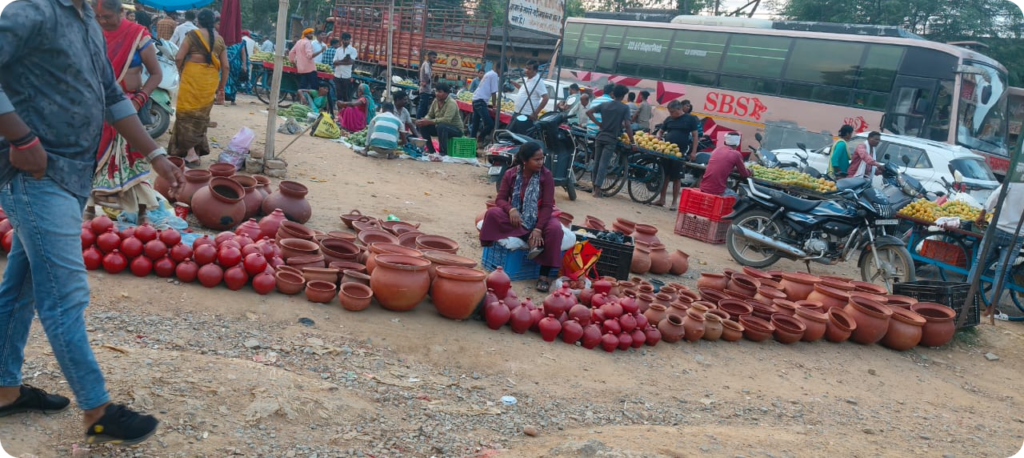
If haats are to be recognised as important rural and tribal food-system institutions, they require more than just appreciation. Many of these haats operate in open spaces with limited infrastructure. Basic support, such as weather protection, safe drinking water, sanitation, storage space, fair weighing systems, waste management, and local oversight can improve market conditions, strengthen food safety, and enhance the security of exchange for both sellers and buyers.
The Government of India2 has proposed upgrading twenty-two thousand rural haats into Gramin Agricultural Markets (GrAMs), with infrastructure strengthening through MGNREGS and other schemes, and support through the Agri-Market Infrastructure Fund. This policy direction recognises the potential of rural markets located close to communities and farm gates. However, effective implementation requires locally appropriate planning that protects the informal, accessible, and community-oriented character of haats while improving basic facilities and transparency.
Strengthening Self-Help Groups (SHGs), producer groups, and local farmer collectives, and further linking them with haats, can improve aggregation of local produce, bargaining power, and value chains for smallholder farmers and women vendors. Nutrition-sensitive strategies can also use haats as platforms for promoting diverse, seasonal, indigenous, and minimally processed foods while addressing risks related to ultra-processed foods and food safety. For researchers, programme implementers, and policymakers working on rural and tribal livelihoods, food systems, or nutrition, weekly haats deserve serious attention as active institutions that can support dietary diversity, local economies, and culturally grounded food practices.
——————————————————
This blog was authored by Dr. Mamta Thakur, Sangeeta Sharma, and Ayushi Dhasmana. Edited and curated by Dr. Suparna Ghosh Jerath.
About the co-authors:
Mamta Thakur- Mamta is a Research Fellow at NIHR Global Health Research Centre for Non-Communicable Diseases and Environmental Change. An anthropologist with more than a decade of experience in the research and academic field; Dr. Thakur has worked extensively with tribal and non-tribal populations across diverse health and nutritional domains. Her expertise includes qualitative and mixed methods research, community engagement, monitoring and evaluation.
Sangeeta Sharma- Sangeeta Sharma is a Research Officer at NIHR Global Health Research Centre for Non-Communicable Diseases and Environmental Change. With more than a decade’s experience in the public health field, Sangeeta has contributed to numerous projects. Implementing programs pertaining to mother and child health, infectious and non-communicable illnesses, community health worker capacity building, monitoring, and evaluation.
Ayushi Dhasmana- Ayushi is a public health nutrition researcher with a master’s degree in food and nutrition. She is currently pursuing her PhD at the University of Delhi, in collaboration with the George Institute for Global Health, India. Her research focusses on assessing food systems, especially public food programs, with the goal of increasing their efficacy for better nutritional outcomes for marginalised people and environmental co-benefits.
About the editor:
Dr. Suparna Ghosh Jerath– Suparna is a nutritionist by training and has more than twenty-six years of experience as a clinical, academic and research nutritionist. Dr. Ghosh – Jerath is the Program Head for Nutrition at The George Institute for Global Health, India. Her research interests include developing innovative tools for nutritional assessment, evaluation of nutrition-specific programs, developing low-cost food-based solutions to address malnutrition and food policies to address non -communicable diseases in India.
This research was funded by the NIHR (Global Health Research Centre for Non-communicable Diseases and Environmental Change) using UK international development funding from the UK Government to support global health research. The views expressed in this publication are those of the author(s) and not necessarily those of the NIHR or the UK government.